By Rob Collewijn, PT, Founder of Free Motion Physical Therapy Published October 2026
Knee pain on stairs is usually caused by one of two things: irritation where the kneecap glides over the thigh bone (called patellofemoral pain), or early wear in the knee joint (osteoarthritis). Stairs bring these problems out first because every step asks your knee to bend while it carries your full body weight. The good news is that both usually respond well to the right kind of exercise, and a physical therapy evaluation can tell you which one you're dealing with.
On flat ground, your knee stays fairly straight. On stairs, it has to bend deeply and control your body weight at the same time. That combination puts much more pressure on the joint behind the kneecap than ordinary walking does.
Going down is often worse than going up. When you step down, your thigh muscles work like brakes, lowering you slowly instead of letting you drop. If those muscles, or the hip muscles that keep your knee lined up, aren't doing their job well, the knee takes more of the load than it should.
That's why stairs are so often the first place people notice a problem. Researchers following more than 4,600 people with or at high risk of knee osteoarthritis found that pain on stairs was the first weight-bearing activity where knee pain showed up, before walking, standing, or pain at rest.
This is the most common cause I see in active adults. It feels like a dull ache at the front of the knee, around or behind the kneecap. The American Academy of Orthopaedic Surgeons describes the typical pattern on its patellofemoral pain syndrome guide: pain with activities that repeatedly bend the knee, such as climbing stairs, squatting, or running, and pain after sitting for a long time with your knees bent, like on a long drive or a flight.
Other clues:
It's often worse going down stairs than up.
You may hear clicking or grinding, usually without swelling.
It often starts after a change in activity, such as a new workout, more walking on vacation, or picking up pickleball.
In people over 40, stair pain can be an early sign of osteoarthritis, the gradual wear of the cartilage that cushions the joint. It often comes with stiffness first thing in the morning or after sitting, and it tends to build slowly over months rather than appearing overnight.
Osteoarthritis is not a reason to stop moving. The 2019 American College of Rheumatology and Arthritis Foundation guideline lists exercise among its most strongly recommended treatments for knee osteoarthritis.
Pain just below the kneecap can come from the patellar tendon. Pain along the inside or outside of the joint, especially with twisting, catching, or locking, can point to the meniscus. Our guide to why your knee hurts, by where the pain is walks through these patterns in more detail.
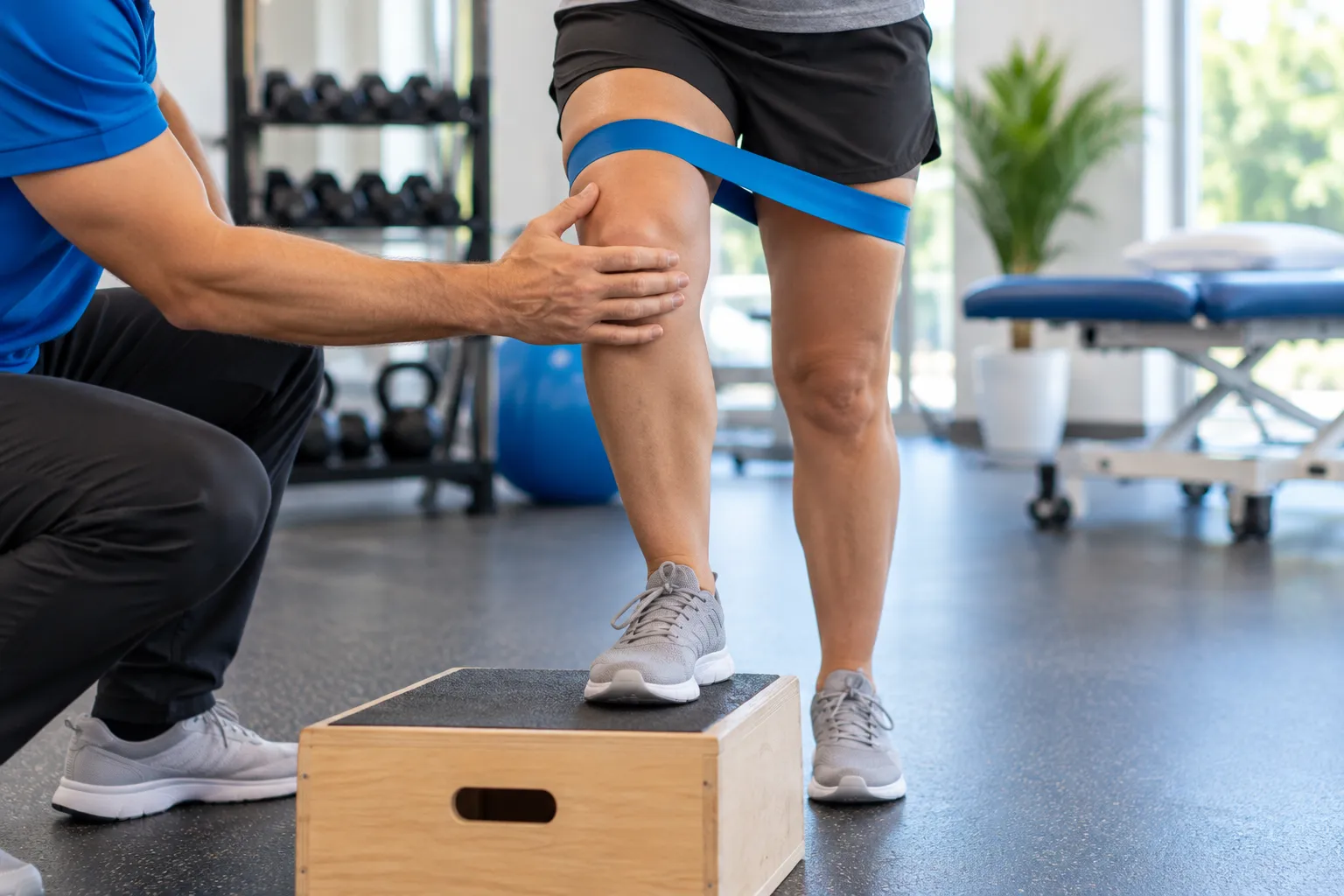
Your knee sits between your hip and your ankle, and it often pays for problems at either end. When the muscles on the outside and back of the hip are weak or slow to switch on, the knee tends to drift inward as you step, and the kneecap takes extra stress. Stiff ankles can do something similar by forcing the knee to make up the difference.
This matches what the research shows. The physical therapy clinical practice guideline for patellofemoral pain, published in the Journal of Orthopaedic & Sports Physical Therapy, recommends combining hip-focused and knee-focused strengthening, with hip work often emphasized early.
At Free Motion, this is where my Scale of Function comes in. It's a step-by-step approach: we find the level of movement you can do well, then progress you one step at a time toward the activity that hurts, whether that's a flight of stairs, a morning walk, or a match on the court.
For patellofemoral pain, the evidence is clear. A patient summary of the JOSPT guideline notes that a combined hip and knee strengthening program worked better than knee exercises alone. The key word is progressive: exercises have to get harder as your knee gets stronger, at a pace your knee tolerates.
Rest alone rarely fixes this. The goal is to reduce the activities that flare your knee for a while, keep doing the ones that don't, and build back up gradually.
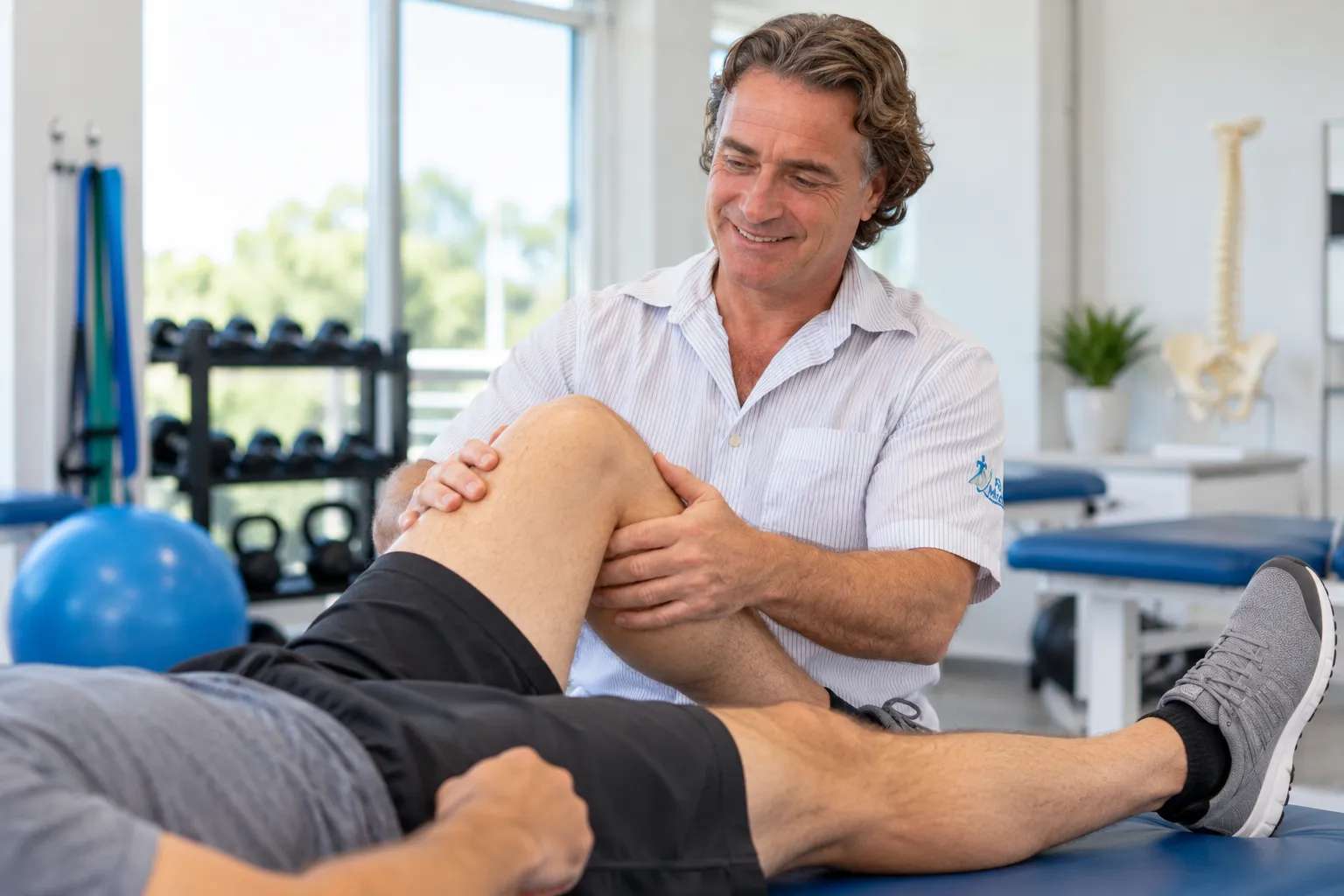
Every visit at Free Motion starts with hands-on treatment. Manual work on the joint and surrounding tissue can make movement more comfortable so you can do the exercises that create lasting change.
Kneecap taping or simple inserts may help some people with patellofemoral pain in the short term, but the JOSPT guideline recommends them only alongside exercise, not in place of it.
The same guideline found that passive treatments, such as lying still while electrical stimulation is applied, are not helpful for patellofemoral pain. That's worth knowing, because a lot of clinics lean on them.
When we use Neubie, a neuromuscular electrical stimulation device made by NeuFit, it's during active movement, not instead of it. It helps us find muscles around the hip and knee that aren't activating well and work on them while you move. Exercise still does the heavy lifting. You can see how Neubie fits with our other tools on the therapeutic equipment page.
These are general tips, not a substitute for an evaluation. Stop anything that causes sharp pain.
Use the handrail and take stairs one step at a time while your knee is irritated.
Lead with your stronger leg going up, and your sorer leg going down. Physical therapists often teach this as "up with the good, down with the bad."
Break up long sitting. Stand and straighten your knees every 30 to 45 minutes.
Keep moving on flat ground. Walking on level surfaces is usually easier on the knee than stairs or hills.
Don't push through pain that lingers. If your knee hurts more the next morning, you did too much the day before.
For more, see our guide to rehabilitating a painful knee at home and our exercises and stretches service.

Physical therapy is a good starting point for most stair-related knee pain, but see a physician promptly if you have any of these:
Significant swelling, especially right after a fall, twist, or pop
A knee that locks, catches, or gives way
Inability to put weight on the leg
Redness, warmth, or fever with knee pain
Numbness, tingling, or pain that travels down the leg
Pain that is getting steadily worse despite rest
If stairs have started to hurt, the earlier you find the cause, the simpler the fix usually is. In Florida, you don't need a referral to start. Read our guide on seeing a physical therapist without a referral in Florida to learn how it works.
At Free Motion, your first visit includes a hands-on evaluation of your knee, hip, and ankle so we can see what's driving the pain and build a plan around it. Learn more about our physical therapy services, take the Free Physical Analysis, or schedule your first visit.
Why does my knee hurt going down stairs but not up? Going down asks your thigh muscles to control your weight as you lower yourself. If those muscles or your hip muscles aren't controlling the knee well, the joint behind the kneecap takes extra stress. This pattern is common with patellofemoral pain.
Is knee pain on stairs a sign of arthritis? It can be. Research shows stairs are often the first activity where early knee osteoarthritis causes pain. In younger, active people, patellofemoral pain is more common. An evaluation can tell the two apart.
Should I avoid stairs if my knee hurts? Usually not entirely. Cut back on the amount that flares your knee, use the handrail, and take one step at a time while you build strength. Complete avoidance can make the muscles that protect the knee weaker.
Can physical therapy help knee pain on stairs? For most people, yes. Guidelines for both patellofemoral pain and knee osteoarthritis point to exercise as a core treatment. Results vary depending on the cause, which is why the first step is finding out what's going on.
This article is for general education and is not medical advice. Results vary. If you have severe, worsening, or unexplained symptoms, see a physician. A physical therapy evaluation is the best way to learn which options are right for you.
