By Rob Collewijn, PT, Founder of Free Motion Physical Therapy Published November 2026
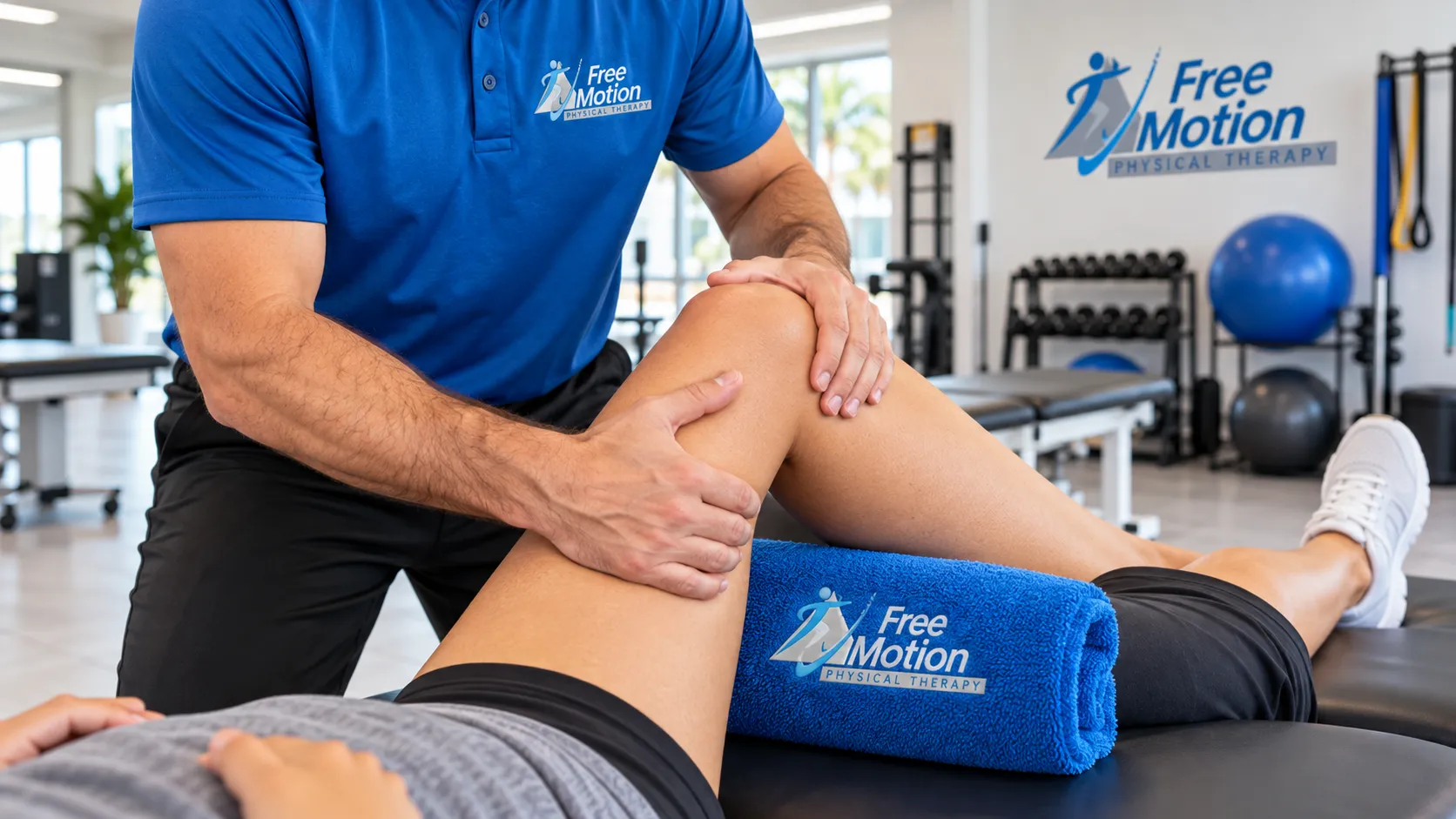
Manual therapy techniques are hands-on treatments a physical therapist uses to move stiff joints and ease tight or sensitive muscles and connective tissue. The two main types are joint mobilization, which uses controlled, graded movement of a joint, and soft tissue mobilization, which uses pressure and stretch on muscles, tendons, and fascia. The research supports them most when they're paired with exercise, which is why hands-on work opens a visit at Free Motion rather than making up the whole visit.
In Florida, manual therapy is written into the legal definition of physical therapy. The state's Physical Therapy Practice Act lists it alongside therapeutic exercise, functional movement training, and patient education as treatments a licensed physical therapist designs and carries out.
That matters for one practical reason: it tells you who should be doing it. If you want to understand how hands-on care fits into a full plan, our manual therapy and physical therapy services in Clearwater page explains how we approach it at Free Motion.
Joint mobilization is a hands-on technique where your physical therapist moves a joint in a specific direction, usually with small, rhythmic movements or a sustained hold. The goal is to restore motion in a joint that has become stiff or isn't gliding the way it should.
Think of a door hinge that's started to stick. You don't fix it by slamming the door harder. You work it back and forth until it moves freely, then you keep using it. Joint mobilization is the working-it-back-and-forth part. Exercise is the keep-using-it part.
Joint mobilization is commonly used for stiffness and pain in the:
Low back and mid back
Neck
Shoulder, especially when reaching overhead is limited
Knee and hip, including stiffness related to arthritis
Ankle, often after a sprain
For low back pain, the physical therapy clinical practice guideline published in the Journal of Orthopaedic & Sports Physical Therapy recommends joint mobilization to reduce pain and disability for both short-term (acute) and long-lasting (chronic) back pain.
For knee osteoarthritis, a randomized trial in the New England Journal of Medicine compared a physical therapy program that included manual therapy and exercise with steroid injections. At one year, the physical therapy group had better pain and function scores.
Most people describe joint mobilization as pressure and movement rather than pain. You may feel a stretch at the end of the motion. Your physical therapist adjusts the amount of force based on how you respond, so speak up if anything feels sharp.

Soft tissue mobilization is hands-on work on muscles, tendons, ligaments, and fascia (the connective tissue that wraps around muscles). Your physical therapist uses their hands to apply pressure, stretch, or move the tissue in specific directions, often while you move the joint underneath.
It's related to massage, but the purpose is different. In physical therapy, soft tissue work is aimed at a specific movement problem your evaluation found, and it's followed by exercise that uses the range you just gained.
Soft tissue mobilization is commonly used for:
Muscles that feel tight, guarded, or tender to the touch
Areas that tense up to protect an injured joint
Scar tissue after an injury, once it's healed enough to be worked on
Stiffness that limits how far you can move before exercise starts
The same low back pain guideline notes that soft tissue mobilization and massage have some evidence for reducing pain and disability in acute low back pain, and that they can be used together with other treatments for chronic back pain. In other words, soft tissue work is a useful tool, not a stand-alone fix.
Expect firm pressure, sometimes in spots that are tender. Mild discomfort that eases as the tissue relaxes is common. Some people feel a little sore the next day, similar to after a new workout.
Nerve glides (neural mobilization). Gentle, repeated movements that help a nerve slide more freely through the tissues around it. These are sometimes used when back pain comes with pain down the leg, and the low back guideline lists them as an option alongside other treatments.
Muscle energy techniques. You push gently against your physical therapist's hand, then relax, while they guide the joint into a new position. It uses your own muscle contractions to improve motion.
Not every technique fits every person. Your evaluation decides which ones make sense for you.
People often ask whether manual therapy is the same as "getting adjusted." In Florida, they're legally different.
Florida's Physical Therapy Practice Act states that physical therapy does not include practicing chiropractic medicine, including specific spinal manipulation. When a patient needs that specific chiropractic procedure, the law directs the physical therapist to refer them to a licensed chiropractic physician.
Manual therapy in a physical therapy setting focuses on joint mobilization, soft tissue work, and the exercise that follows. Neither approach is "better" in general. They're different tools, delivered by different licensed professionals, and some people benefit from both.
At Free Motion, every visit starts with hands-on treatment. Here's the reasoning.
Manual therapy can make a stiff or guarded area easier to move for a while after treatment. That's a window. If you use that window to move and strengthen in the new range, you have a better chance of keeping it. If you don't, the body tends to drift back to its old pattern.
That's where my Scale of Function comes in. It's a step-by-step approach: hands-on work to open up movement, then exercises matched to the level you can do well today, then progression one step at a time toward the activity that hurts. The hands-on part gets you started. The progression is what holds it in place.
You can see how we build that exercise side on our exercises and stretches page.

Manual therapy is generally low risk when it's done by a licensed physical therapist after a proper evaluation. Part of that evaluation is screening for conditions where hands-on techniques need to be changed or avoided, such as a recent fracture, certain bone or joint conditions, or a surgical area that hasn't been cleared for treatment.
See a physician first if you have:
Pain after a significant fall, accident, or other trauma
Numbness, tingling, or weakness that's getting worse
Loss of bowel or bladder control
Unexplained weight loss, fever, or night pain along with your symptoms
If a joint feels stuck or a tight area keeps limiting how you move, a hands-on evaluation can tell you whether manual therapy makes sense and which techniques fit. In Florida, you don't need a referral to start. Our guide on seeing a physical therapist without a referral in Florida explains how it works.
Learn more about manual therapy at Free Motion, take the Free Physical Analysis, or schedule your first visit.
What are the main manual therapy techniques? The two main types are joint mobilization, which moves a stiff joint with controlled, graded motion, and soft tissue mobilization, which works on muscles, tendons, and fascia with pressure and stretch. Nerve glides and muscle energy techniques are also used in some cases.
What is the difference between joint mobilization and soft tissue mobilization? Joint mobilization targets the joint itself to restore how it moves. Soft tissue mobilization targets the muscles and connective tissue around the joint. Many treatment sessions use both.
Does manual therapy hurt? It usually feels like firm pressure or a stretch. Some tender spots may be uncomfortable, and mild soreness the next day is common. Your physical therapist adjusts the pressure based on how you respond.
Is manual therapy the same as a chiropractic adjustment? No. In Florida, physical therapy does not include specific spinal manipulation, which is a chiropractic procedure. Physical therapists use joint mobilization and soft tissue techniques and refer to a chiropractor when that specific procedure is needed.
Is manual therapy enough on its own? Usually not. Research supports manual therapy most when it's combined with exercise, which helps you keep the movement you gain.
This article is for general education and is not medical advice. Results vary. If you have severe, worsening, or unexplained symptoms, see a physician. A physical therapy evaluation is the best way to learn which options are right for you.
